Mold Removal & Remediation in Diamond Bar, CA — Attic, Two-Story & Canyon-Lot Moisture Specialists
Diamond Bar's older 1960s–80s two-story homes hide moisture well: upstairs leaks travel down inside wall cavities, aging materials trap slow intrusion, and shaded canyon lots never fully dry. That's why mold here grows unseen — in attics, ceilings, and downstairs walls — until it smells. SureDry Restoration Inc. finds it and fixes the source.
Mold Removal Experts Who Know Diamond Bar's Older Homes
Diamond Bar is a city of older, predominantly two-story homes built in the 1960s–80s, set on canyon and hillside lots along Tonner Canyon, Brea Canyon, and The Country Estates. Two things about that make mold a hide-and-seek problem: aging materials that let slow moisture sit unseen inside walls and attics, and a two-story layout that carries upstairs leaks down into the rooms below. SureDry Restoration Inc. is based next door in Pomona — a quick trip up the 57 or 60 — and we know how these older homes trap moisture where you can't see it.
Why Diamond Bar Homes Grow Mold (Older Homes Hide It)
Mold takes hold wherever moisture lingers, which is why the EPA stresses that the key to mold control is moisture control. In Diamond Bar, the moisture usually isn't a burst pipe — it's a small, slow leak that older drywall, windows, and roofing conceal, or upstairs seepage traveling down inside a wall cavity, or canyon shade keeping an exterior wall damp. By the time mold surfaces downstairs or in the attic, the source has often been feeding it for months. Find that source and the mold stops; miss it and it returns.
Mold Problems We See Most in Diamond Bar
Older drywall, original single-pane and aluminum windows, and decades-old roofing and flashing let slow intrusion sit inside assemblies. The aged, organic-rich materials feed mold that surfaces as musty closets, window-frame staining, and soft spots.
Upstairs bathroom, shower-pan, and laundry seeps route down inside interior wall cavities, growing mold in the ceiling and walls of the room below before a stain ever shows upstairs — a signature two-story failure.
Hillside and canyon lots along Tonner Canyon, Brea Canyon, and The Country Estates channel runoff and hold soil moisture against foundations and lower-level earth-side walls, keeping framing and insulation damp enough for hidden mold on downhill sides.
Heavy canopy and canyon shade slow evaporation on exterior walls and roofs, so roof-valley and wall moisture lingers. Surface mold and mustiness build on the shaded, north-facing side of the house.
Original or dated ductwork and poor attic ventilation cause condensation on cold surfaces, wetting insulation and drywall and seeding attic and ceiling mold — the attic-mold problem, with the real local housing detail behind it.
Is Mold a Health Risk? What the CDC Says
According to the CDC, mold exposure can cause a stuffy nose, sore throat, coughing or wheezing, burning eyes, or a skin rash, and people with asthma or a mold allergy, or with weakened immune systems, may react more severely. Attic and in-wall mold is easy to ignore because you can't see it — but it still circulates spores through the home, which is why a musty upstairs smell is worth investigating.
Our Mold Remediation Process
We inspect the attic, ceilings, and wall cavities with moisture meters and thermal imaging, tracing downstairs mold back up to the real upstairs or roof source.
We isolate the affected area so spores don't spread during removal. Following EPA remediation guidance, larger areas get containment and negative air pressure, matched to the size and location of the growth.
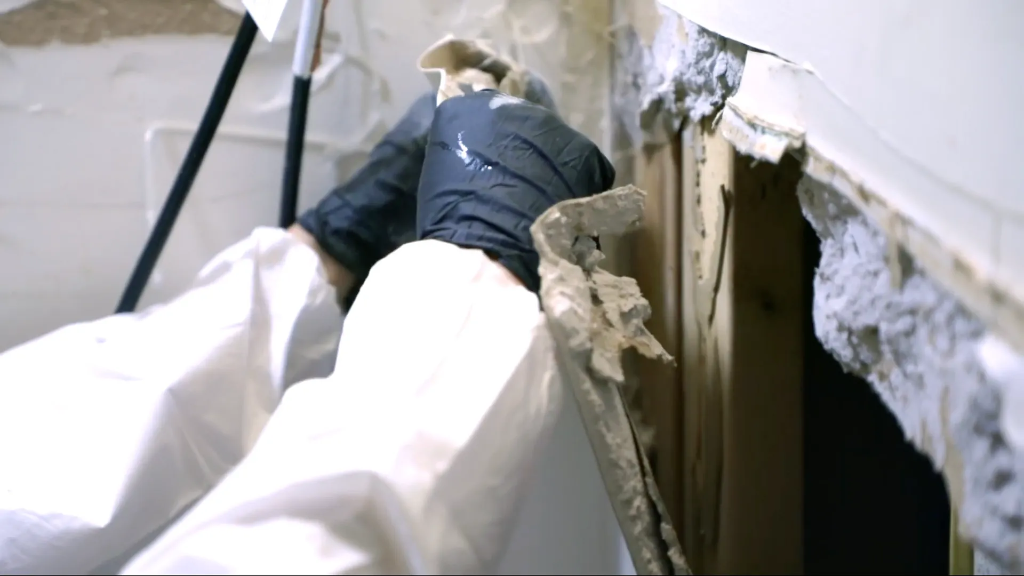
Affected porous materials that can't be cleaned — drywall, insulation, sheathing — are removed and bagged, and the air is scrubbed with HEPA filtration.
Salvageable framing and surfaces are cleaned and treated with EPA-registered antimicrobials.
We correct the upstairs leak, the roof or flashing intrusion, or the attic ventilation driving the condensation — the step that keeps mold from returning.
We replace the drywall, insulation, and finishes we removed and confirm the area is dry and clean — one accountable team from inspection to final repair.
DIY vs. Calling a Pro (the EPA 10-Sq-Ft Rule)
The EPA's guideline is simple: a moldy area under about 10 square feet (a 3-by-3-foot patch) is often a DIY job, while anything larger, or anything following significant water damage, warrants a professional. Attic and wall-cavity mold in Diamond Bar's older two-story homes is almost always larger and more hidden than it looks — the kind of job where opening the wall reveals the real extent.
Residential & Commercial Mold Remediation in Diamond Bar
We serve homes across The Country Estates, the canyon lots, and the older neighborhoods along the 57/60 corridor, plus businesses along Diamond Bar Boulevard and Grand Avenue. Because Diamond Bar mold almost always begins with a hidden leak, our Diamond Bar water damage restoration team and this mold crew are one operation — the leak, the mold, and the rebuild under a single contract. See all restoration services in Diamond Bar.
Musty Attic or Upstairs Smell? Call Us First.
In an older two-story home, the leak is easy to miss and mold spreads inside the cavities until the source is fixed. Pomona-based SureDry Restoration Inc. reaches Diamond Bar fast via the 57/60, handles water and mold under one team, and finds what the templates miss. Call (909) 573-5760 for a mold inspection and a free estimate.