Mold Removal & Remediation in La Verne, CA — Old Town & Older-Home Specialists
La Verne's historic Old Town homes hide mold behind plaster walls and in cavities fed by aging cast-iron drains, and closed-up rentals near the University trap it. SureDry Restoration Inc. finds the moisture source, removes the mold safely, and stops it from coming back — dispatching from neighboring Pomona.
Mold Removal Experts Who Know La Verne Homes
La Verne's oldest homes hide moisture the best. The Old Town and Lordsburg core, dating to the early 1900s–1920s, runs corroded galvanized supply lines and cracked cast-iron drains inside plaster walls that hold damp for a long time. Add the closed-up student rentals near the University of La Verne and the foothill humidity up toward Marshall Canyon, and you get a city where mold grows out of sight. SureDry Restoration Inc. dispatches from neighboring Pomona and knows exactly where to look.
Why La Verne Homes Grow Mold
Mold only needs moisture, which is why the EPA is blunt that the key to mold control is moisture control. In La Verne that moisture hides behind old plaster, seeps from a cracked cast-iron drain, or builds in a closed-up rental — the slow, concealed kind that grows mold for months before anyone notices. Fix the source and the mold has nothing to feed on; miss it and it comes right back.
Mold Problems We See Most in La Verne
In the early-1900s Old Town and Lordsburg homes, a slow seep from a corroded supply line or a cracked cast-iron drain keeps the plaster-and-lath wall cavity damp. Mold colonizes the framing and the back of the plaster long before a stain shows.
Older rentals near the University of La Verne sit closed up between terms, and an undried leak or trapped humidity builds mold in bathrooms, closets, and around windows — often found when a new tenant moves in.
Newer hillside homes toward Marshall Canyon and Live Oak take canyon runoff and hold ground moisture against foundations, feeding mold on lower-level and earth-side walls that never fully dry.
In La Verne's two-story foothill homes, an upstairs bathroom or laundry seep travels down inside a wall cavity, growing mold in the ceiling and walls of the room below before a stain appears upstairs.
In Old Town's early-1900s homes, cracked and corroded cast-iron drain lines weep inside walls and under floors, keeping framing damp and growing mold along the drain run — a source unique to housing this old, and invisible until it smells.
Is Mold a Health Risk? What the CDC Says
According to the CDC, mold exposure can cause a stuffy nose, sore throat, coughing or wheezing, burning eyes, or a skin rash, and people with asthma or a mold allergy, or with weakened immune systems, may react more severely. In La Verne's older Old Town homes, where mold hides behind plaster and inside two-story wall cavities, that hidden growth can circulate spores through the house — so a lingering musty smell is worth investigating even when nothing is visible.
Our Mold Remediation Process
We find the mold and the moisture feeding it with meters and thermal imaging — behind plaster, under floors, in wall cavities — because remediation that doesn't fix the source only buys time.
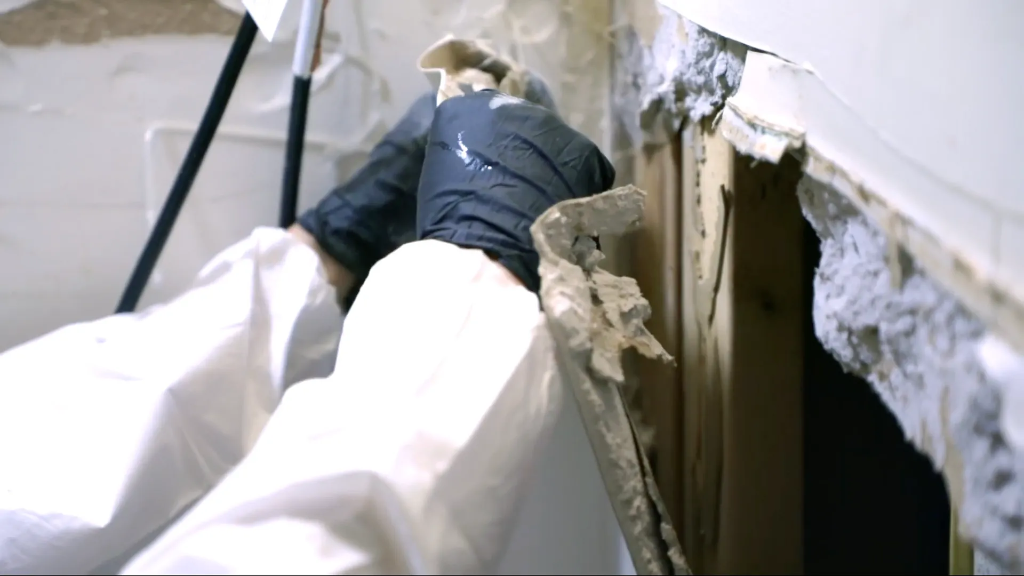
We isolate the affected area so spores don't spread. Following EPA remediation guidance, larger areas get containment and negative air pressure, matched to the size and location.
Affected porous materials that can't be cleaned are removed and bagged, and the air is scrubbed with HEPA filtration.
Salvageable framing and surfaces are cleaned and treated with EPA-registered antimicrobials.
The step that lasts — we correct the aging pipe, the drain, or the drainage driving the moisture, so the mold doesn't simply grow back.
We restore the plaster, drywall, and finishes we removed — matching original materials where possible — and confirm the area is dry and clean.
DIY vs. Calling a Pro (the EPA 10-Sq-Ft Rule)
The EPA offers a practical line: if the moldy area is less than about 10 square feet (roughly a 3-by-3-foot patch), a homeowner can often handle it. Once it's larger, or hidden inside the wall cavities of an Old Town home, it's time for a professional — exactly the kind of hidden, larger-than-it-looks growth we find in La Verne.
Residential & Commercial Mold Remediation in La Verne
We serve homes across Old Town, the mature central neighborhoods, and the newer foothill tracts toward Marshall Canyon, plus the University of La Verne and businesses along Foothill and Bonita. Because La Verne mold almost always starts with water, our La Verne water damage restoration team and this mold crew are one operation — the leak, the mold, and the rebuild under a single contract. See all restoration services in La Verne.
Musty Smell or Visible Mold? Call Us First.
Mold spreads and the moisture keeps feeding it until the source is fixed — so the sooner we look, the smaller the job. SureDry Restoration Inc. reaches most La Verne addresses within the hour and handles water and mold under one team. Call (909) 573-5760 for a mold inspection and a free estimate.