Mold Removal & Remediation in Montclair, CA — Postwar-Home Moisture Specialists
Montclair's 1950s–60s homes were never built to breathe: fan-less bathrooms, single-pane windows that sweat all winter, thin insulation, and decades of conversions without vapor barriers. That's why mold here is a housing-stock problem, not bad luck. SureDry Restoration Inc. finds the moisture source, removes the mold safely, and stops it from coming back.
Mold Removal Experts Who Know Montclair Homes
Roughly half of Montclair's housing dates to the 1940s–60s, and those homes share the same moisture weaknesses: bathrooms that vent steam through a window instead of a fan, aluminum-frame windows that condense every cold morning, exterior walls with little or no insulation, and garage conversions and additions built without vapor barriers. High occupancy and a large rental stock add cooking and shower humidity on top. SureDry Restoration Inc. dispatches from Pomona next door, and we know exactly where mold hides in this generation of housing.
Why Montclair Homes Grow Mold
Mold only needs lingering moisture, which is why the EPA is blunt that the key to mold control is moisture control. In Montclair the moisture is rarely a flood — it's daily humidity that the house can't exhaust: shower steam with no fan, window condensation with nowhere to go, and cold uninsulated walls where damp air settles. Fix the ventilation and the source, and the mold stops; paint over it, and it returns on schedule.
Mold Problems We See Most in Montclair
Many original Montclair bathrooms have no exhaust fan at all. Decades of shower humidity feed mold on ceilings and in wall cavities — remediation plus adding real ventilation breaks the cycle instead of just repainting over it.
Original aluminum-frame windows sweat on cold mornings, and the moisture wicks into sills and drywall returns. It shows up as recurring black speckling in bedrooms — usually worse in rooms where doors stay closed.
Add-on walls built without vapor barriers or proper flashing let moisture in at the old garage slab and roof tie-ins. Mold grows undetected behind paneling until tenants report a musty smell or allergy symptoms.
With little wall insulation, exterior walls run cold, and beds or dressers pushed tight against them trap condensation. It's one of the most common patterns we open up in the '40s–'60s housing that makes up half of Montclair's stock.
Montclair's older rental stock changes hands frequently, and landlords discover moisture damage and mold when a unit is vacated. Documented remediation helps protect the owner on habitability and gets the unit re-rentable fast.
Is Mold a Health Risk? What the CDC Says
According to the CDC, mold exposure can cause a stuffy nose, sore throat, coughing or wheezing, burning eyes, or a skin rash, and people with asthma or a mold allergy, or with weakened immune systems, may react more severely. In Montclair's high-occupancy homes and rentals, that daily low-level exposure is exactly why a persistent musty smell deserves an inspection rather than another coat of paint.
Our Mold Remediation Process
We find the mold and the moisture feeding it with meters and thermal imaging — behind paneling, inside conversions, around windows — because remediation that doesn't fix the source only buys time.
We isolate the affected area so spores don't spread. Following EPA remediation guidance, larger areas get containment and negative air pressure, matched to the size and location of the growth.
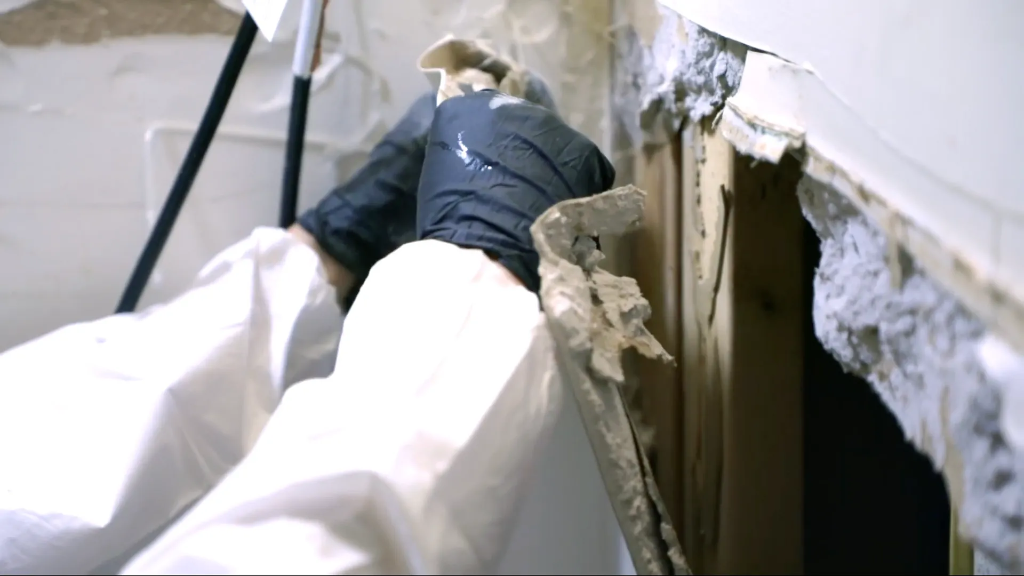
Affected porous materials that can't be cleaned are removed and bagged, and the air is scrubbed with HEPA filtration.
Salvageable framing and surfaces are cleaned and treated with EPA-registered antimicrobials.
The step that lasts — correcting the ventilation, the flashing, or the failing pipe behind the growth, so the mold doesn't simply come back.
We restore the drywall, paneling, and finishes we removed and confirm the area is dry and clean — one team, one contract.
DIY vs. Calling a Pro (the EPA 10-Sq-Ft Rule)
The EPA's rule of thumb: a moldy area under about 10 square feet (a 3-by-3-foot patch) is often a DIY job, while anything larger, or anything following significant water damage, calls for a professional. Montclair's conversion and wall-cavity mold is almost always bigger than what shows on the surface — the exact case where a proper inspection saves money over a repaint that fails in a month.
Residential & Commercial Mold Remediation in Montclair
We serve homes and rentals across the city's postwar neighborhoods, plus the businesses around Montclair Place and the Holt Boulevard corridor. Because Montclair mold almost always traces back to moisture the house can't exhaust — or to a leak, our Montclair water damage restoration team and this mold crew are one operation. See all restoration services in Montclair.
Musty Smell or Visible Mold? Call Us First.
Mold spreads and the moisture keeps feeding it until the source is fixed — so the sooner we look, the smaller the job. SureDry Restoration Inc. reaches most Montclair addresses in about 10 minutes and handles water and mold under one team. Call (909) 573-5760 for a mold inspection and a free estimate.