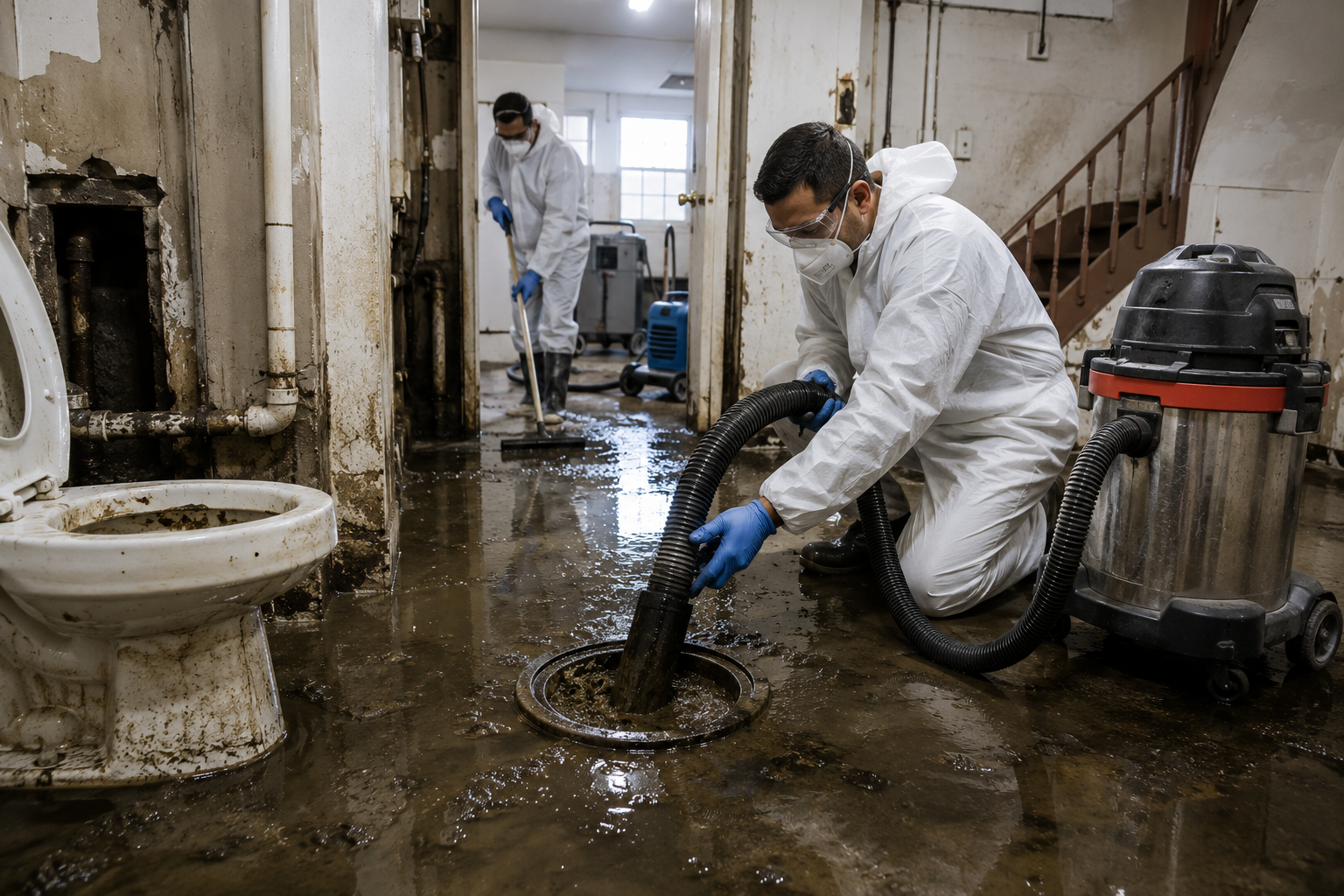
Sewage on the floor right now? Stop using all water in the house, keep everyone away from the area, and call SureDry Restoration at (909) 573-5760 — we dispatch certified cleanup crews 24/7 across Pomona and LA County. If you have a few minutes to understand what you're dealing with, this guide covers the first steps, the real dangers, what cleanup costs, and who ends up paying.
The First 30 Minutes: 6 Steps to Take Right Now
- Stop all water use in the house. Every flush, shower, and dishwasher cycle sends more water into a blocked line and back onto your floor.
- Keep people and pets out. Sewage is contaminated water — children, seniors, pets, and anyone with a weakened immune system should not go near it.
- Cut power to the area if it's safe. If water is near outlets, appliances, or the panel, shut off the breaker for that zone — without standing in the water to do it.
- Check whether it's one fixture or many. One backed-up toilet may be a local clog. Sewage rising in tubs, showers, and floor drains at once means a main-line blockage — nothing you run will drain.
- Photograph everything before touching anything. Your insurance claim depends on documentation of the water, the spread, and what it touched.
- Call for professional cleanup. A plumber clears the line, but the contaminated water, materials, and surfaces need certified biohazard cleanup — that's our 24/7 flood cleanup and water extraction team.
Why a Sewage Backup Is a Genuine Health Emergency
The restoration industry doesn't treat sewage like ordinary water damage, and neither should you. Under the ANSI/IICRC S500 standard — the professional standard for water damage restoration — sewage is Category 3 "black water": grossly contaminated water that requires the most protective handling, with porous materials it touches typically removed rather than cleaned.
The pathogens in this water
This isn't theoretical. The CDC warns that floodwater and sewage can contain disease-causing bacteria such as E. coli and Salmonella, and its guidance on re-entering a flooded home cautions that a home contaminated with sewage can make you sick. That's also why CDC guidance for handling sewage calls for waterproof gloves, rubber boots, goggles, and a protective mask — equipment most households don't have on hand.
Sewer gases and the air you're breathing
A backup doesn't just contaminate surfaces — it releases sewer gases like hydrogen sulfide and methane into your living space, which is why professional crews ventilate aggressively and run air filtration while they work. If the smell is strong enough to be unpleasant, treat it as a sign to stay out.
The 24–48 hour mold clock
The EPA advises that wet materials dried within 24–48 hours will in most cases not grow mold. Miss that window and you're paying for two projects: sewage cleanup and mold remediation. Speed isn't upselling — it's the single biggest factor in keeping the bill down.
Can You Clean Up a Sewage Backup Yourself?
Only if all four of these are true: the spill is tiny (a single small overflow from your own toilet), it's fresh (caught within hours), it's contained to hard surfaces like tile, and nobody vulnerable lives in the home. Even then, wear CDC-level protection and disinfect thoroughly. Everything else — multiple rooms, carpet or drywall contact, water that sat overnight, or any main-line backup — is a professional job. Every authority that publishes on this topic lands in the same place: sewage cleanup is not a DIY project, because the risk isn't the mess you can see, it's the contamination you can't.
How Much Does Sewage Backup Cleanup Cost?
Contractor estimates generally run $7–$14 per square foot, with most jobs landing between $2,000 and $10,000. Treat every figure here as a third-party contractor estimate, not a quote — the honest number comes from an on-site inspection. For a deeper look at how restoration pricing works overall, see our guide to what water damage restoration costs in LA County and the Inland Empire.
Typical price ranges (contractor estimates)
- Minor contained toilet overflow: from around $1,000
- Small jobs (one room, fast response): roughly $2,000–$3,500
- Typical multi-room backup: $2,000–$10,000
- Severe or long-sitting backups with structural damage: $10,000–$15,000+
- Not included: repairing the sewer line itself (a plumbing cost that varies enormously) and a camera inspection of the line, commonly a few hundred dollars.
The factors that move your bill
Square footage affected, how deep the sewage stood, how far it spread, and — above all — response speed. Delay adds a mold phase. Porous materials (carpet, drywall, insulation) drive cost up because they must be removed and replaced; hard surfaces can often be cleaned. Layout matters too: a backup that reached finished living space costs more than one contained to a garage slab.
What You'll Have to Throw Away (and What Can Be Saved)
Usually discarded: carpet and padding, upholstered furniture, mattresses, and sewage-saturated drywall and insulation — typically flood-cut above the water line. The EPA notes that porous materials such as carpet and ceiling tiles often have to be thrown away once they become moldy — and the same logic applies to sewage-soaked absorbent materials, which can't be reliably disinfected. Usually saved: tile, sealed concrete, metal, and other hard, non-porous surfaces, which can be cleaned and disinfected properly. A good crew documents every discarded item for your claim.
Does Homeowners Insurance Cover Sewage Backup?
Generally no — not without a specific endorsement. The Insurance Information Institute notes that sewer backups are not covered under a typical homeowners policy, nor by flood insurance — coverage requires a separate water/sewer backup endorsement, which insurers commonly offer as an inexpensive add-on with limits that vary by policy. If you're reading this before an emergency: call your agent and ask about it this week. It's one of the cheapest gaps to close in home insurance.
How to document the loss for your claim
Notify your insurer immediately. Photograph and video everything before cleanup begins. Keep samples or photos of discarded materials, itemize losses, and keep the mitigation company's moisture readings and scope of work. We prepare this documentation on every job — it's a large part of why claims move faster with a professional crew involved.
Who Pays: You or the City?
In most jurisdictions, including much of LA County, the homeowner owns the sewer lateral — the pipe from your house to the city main, often including the stretch under your sidewalk. Clogs, tree roots, and breaks in the lateral are typically your responsibility to fix and your damage to clean up.
You own the lateral — what that means locally
In older Pomona, Claremont, and La Verne neighborhoods, mature street trees and decades-old clay laterals make root intrusion one of the most common backup causes we see. The tree may be the city's; the root-choked lateral is still typically yours.
When the city may be liable — and why you still shouldn't wait
If the backup originates in the city main — a blockage or a storm surcharge — the city may be liable. Report it to public works immediately, document everything, and file a damage claim. But don't wait for the city to respond before starting cleanup: municipal liability often turns on notice and negligence and can take months to resolve, while the contamination and mold damage in your home compound by the day. Mitigate now, pursue the claim in parallel.
What Causes Sewer Backups — and How to Prevent the Next One
The usual suspects: main-line clogs from wipes and grease ("flushable" wipes aren't), tree-root intrusion, aging or collapsed clay lines, and heavy rain overwhelming city mains. Prevention that actually works: never flush wipes, keep grease out of drains, have roots treated or the line scoped if you've backed up before, and — the big one for repeat victims — install a backwater valve, which physically blocks sewage from flowing back into the house. If you've had one backup, the odds of another are high enough that the valve usually pays for itself.
Sewage Backup in Pomona or the Inland Empire? We're On Call 24/7
SureDry Restoration handles certified Category 3 sewage cleanup across Pomona, Claremont, La Verne, San Dimas, Chino, Chino Hills, Diamond Bar, and greater LA County — extraction, sanitizing, drying to the standard that stops the mold that follows water damage, and full repairs, with your insurance documentation handled. Call (909) 573-5760 now, or request a free estimate — the sooner cleanup starts, the smaller the job.
Frequently Asked Questions
Is a sewage backup dangerous?
Yes. Sewage is classified as Category 3 'black water' under the ANSI/IICRC S500 restoration standard, and the CDC warns that floodwater and sewage can contain disease-causing bacteria such as E. coli and Salmonella. Children, seniors, pets, and anyone immunocompromised should stay completely away from the affected area until it is professionally cleaned and sanitized.
Can I clean up a sewage backup myself?
Only for a tiny, fresh overflow from your own fixture — caught within hours, contained to a small hard-surface area, with no vulnerable people in the home. Even then, CDC guidance calls for waterproof gloves, rubber boots, goggles, and a mask. Anything larger, older, or touching porous materials like carpet or drywall is a professional biohazard job.
How much does sewage backup cleanup cost?
Contractor estimates generally run about $7–$14 per square foot. Most jobs land between $2,000 and $10,000, a minor contained toilet overflow can be closer to $1,000, and severe or long-sitting backups with structural damage can exceed $15,000. The exact number depends on the spread, the depth, and how fast cleanup starts.
Does homeowners insurance cover sewer backup?
Generally no. The Insurance Information Institute notes sewer backups are not covered by a typical homeowners policy — or by flood insurance. Coverage requires a separate water/sewer backup endorsement added to your policy. If you have the endorsement, document everything and notify your insurer immediately; we help with that documentation on every job.
Who is responsible for a sewer backup — the city or the homeowner?
In most jurisdictions, including much of LA County, the homeowner owns the sewer lateral — the line from the house to the city main, often including the stretch under the sidewalk. Clogs, roots, and breaks there are generally your responsibility. If the backup starts in the city main, the city may be liable — report it and file a claim, but start mitigation immediately either way.
What should I throw away after a sewage backup?
Porous materials the sewage touched usually cannot be safely saved: carpet and padding, upholstered furniture, mattresses, and saturated drywall and insulation (cut out above the water line). The EPA notes absorbent materials may have to be discarded when contaminated. Hard, non-porous surfaces can typically be cleaned and disinfected.