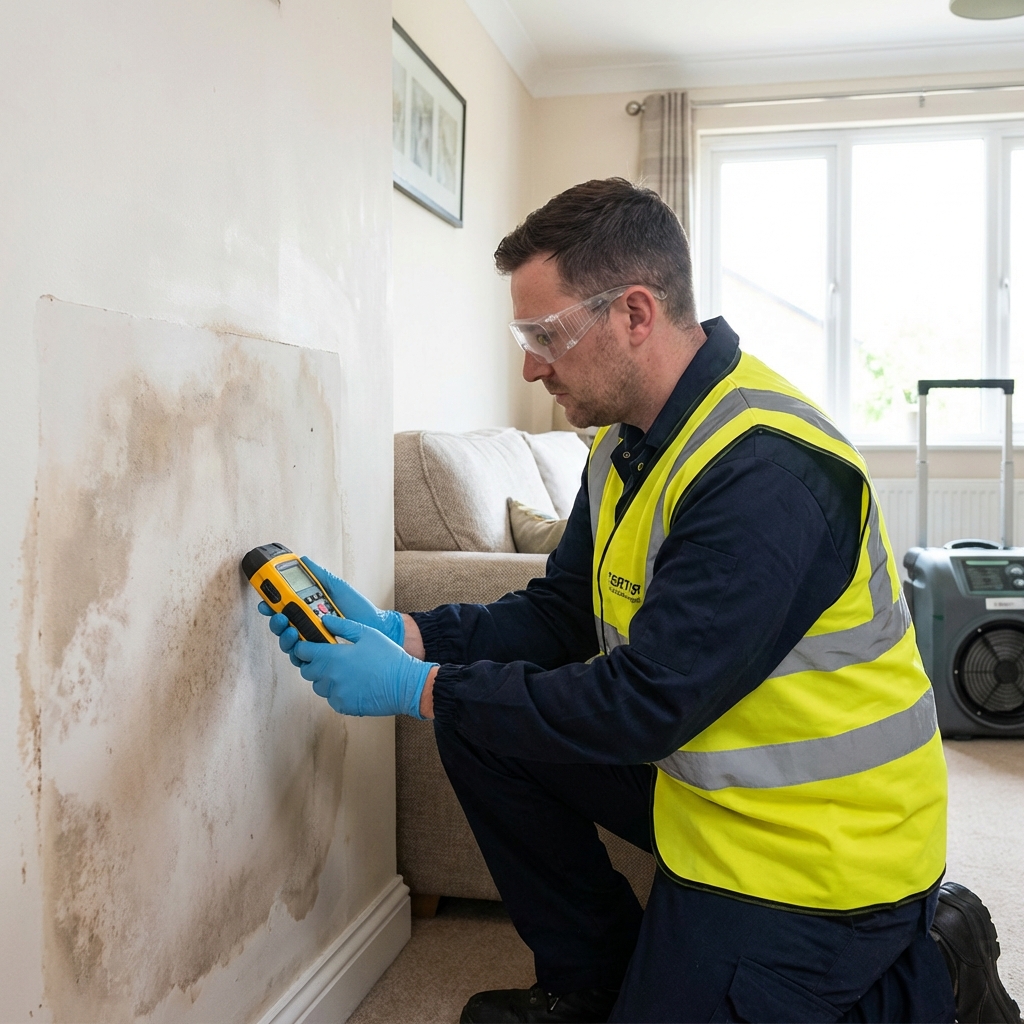
The extraction truck leaves, the carpet feels dry underfoot, and it seems like the emergency is over. Six weeks later there's a musty smell in the hallway and dark spotting at the baseboard. What happened in between is the phase most homeowners never see and most cut-rate jobs skip: structural drying — the measured removal of moisture from the building itself, not the water on top of it.
What Structural Drying Actually Is
Water damage has two layers. The first is the water you can see and pump out. The second is the moisture that has already migrated into the materials — drywall, framing, subfloor, insulation, and the slab — where it can't be squeegeed, mopped, or wiped. Structural drying is the controlled process of getting that second layer back to normal.
It is governed in the restoration industry by the ANSI/IICRC S500 standard, the consensus standard for professional water damage restoration. A practitioner's walkthrough of the standard's field application in Cleaning & Restoration magazine lays out what that means on a real job: psychrometry (the science of air and moisture), deliberate air movement, dehumidification, and ongoing monitoring toward a documented drying goal — not a fixed number of days and not a visual judgment.
Why "Dry to the Touch" Is the Most Expensive Phrase in Restoration
A surface dries first. That's the trap. Drywall can feel completely dry while the bottom plate behind it, the insulation in the cavity, and the subfloor under the finish are still holding water. Wood and paper-faced gypsum will feel normal to your hand well before their moisture content is anywhere near normal.
The stakes are set by the mold clock. The EPA advises that wet or damp materials be dried within 24 to 48 hours to prevent mold growth, and is equally direct that the key to mold control is moisture control. A job declared finished on the strength of how a wall feels routinely leaves damp cavities that turn into a mold remediation project a month or two later — the sequence we describe in our guide to mold signs after water damage.
The Three Levers: Airflow, Dehumidification, Temperature
Air movement
Air movers aren't there to "blow things dry." They're there to break the thin boundary layer of saturated air that clings to wet surfaces and stalls evaporation. Placement and angle matter more than horsepower — this is why a professional setup looks deliberate rather than like a room full of fans.
Dehumidification
Air movement pushes moisture into the air. If nothing removes it, that humid air simply re-condenses somewhere else in the building — often into materials that were dry before. Commercial dehumidifiers pull that moisture out and drain it away. Airflow without dehumidification doesn't dry a house; it redistributes the problem.
Temperature
Warmer air holds more moisture and speeds evaporation, so temperature is managed as part of the system. This is also why "just open the windows" is unreliable in Los Angeles: on a marine-layer morning, outside air can be more humid than inside air, and you end up importing moisture rather than exporting it.
How Drying Gets Verified (the part that protects you)
Here's the difference between a drying job and a drying process: measurement. Crews take moisture readings at the same marked locations every day and track them against a dry standard — the moisture content of the same material in an unaffected part of the building. When affected materials reach that benchmark, drying is complete. Not when it looks done.
Those daily readings do double duty. They tell the crew when to pull equipment, and they give your insurance carrier a defensible record of what was wet, how wet, and how it was resolved. If a company can't produce moisture logs, you have no proof the structure was ever actually dried — and no leverage if a mold claim gets contested later.
What Makes a Job Take Longer
- Material density. Hardwood, plaster, and concrete give up moisture slowly and often need specialty equipment such as floor drying mats.
- Trapped assemblies. Wall cavities, under-cabinet toe kicks, and the space beneath vinyl plank hold water that surface airflow never reaches — controlled cavity access is often required.
- Water category. Contaminated water changes the job from drying to removal-plus-drying, because porous materials it touched typically can't be salvaged.
- How long it sat. Every day before drying starts adds days to drying — and raises the odds of a mold phase.
Structural Drying Across Los Angeles and the Inland Empire
Local building stock changes the work. Slab-on-grade tract homes hide moisture under flooring and in bottom plates; older LA-area homes with plaster and lath dry more slowly and reward drying-in-place over demolition; two-story homes route upstairs leaks down into ceilings and interior wall chases. Coastal-influenced humidity in West LA and the marine layer make ambient conditions a real variable rather than a footnote. In each case the method is the same and the settings are not — which is exactly why the readings, not a stopwatch, decide when the equipment comes out.
Questions Worth Asking Any Restoration Company
- What is my dry standard, and how did you establish it?
- Will I get daily moisture readings, in writing?
- Are you drying in place, or removing material — and why?
- How many dehumidifiers, and what's the plan if readings stall?
- What documentation goes to my insurance carrier?
Good answers to those five questions predict the outcome better than any price quote. For how drying costs fit into the total, see our water damage restoration cost guide.
Need Structural Drying in Los Angeles or the Inland Empire?
SureDry Restoration Inc. dries to a documented standard — moisture mapping, engineered air movement and dehumidification, daily readings, and a written record for your claim — then repairs what was removed. We serve Los Angeles, Pomona, and the surrounding Inland Empire communities with 24/7 water damage restoration. Call (909) 573-5760 or request a free estimate — and if someone already told you it's dry, we can verify that with a meter before you rebuild over it.
Frequently Asked Questions
What is structural drying?
Structural drying is the controlled process of removing moisture from a building's materials — framing, subfloor, drywall, insulation, and concrete — after water damage. It's the phase between extracting standing water and rebuilding, and it uses air movers, dehumidification, and temperature control, verified with daily moisture readings rather than by look or feel.
How long does structural drying take?
Most residential jobs run roughly 3 to 5 days, but the honest answer is that it takes as long as the readings say. Dense, low-evaporation materials like hardwood, plaster, and concrete take longer; a lightly affected room with good airflow can finish sooner. Any company quoting a fixed number before measuring is guessing.
Why can't I just use fans and open windows?
Because airflow alone only moves moisture into the air — something has to remove it, or it re-condenses into other materials and spreads the problem. Open windows can also import humidity on a marine-layer morning in Los Angeles. Professional drying pairs air movement with dehumidification so evaporated moisture actually leaves the structure.
What is a 'dry standard'?
A dry standard is the target moisture content for a material, established by measuring the same material in an unaffected part of the building. Drying is complete when affected materials reach that benchmark — not when a surface feels dry. It's what turns 'we think it's dry' into a documented, defensible endpoint for your insurance file.
Does drywall always have to be removed after water damage?
No — that's a common misconception. Drywall can often be dried in place with the right equipment and cavity access, especially with clean water caught quickly. Removal becomes necessary when the water was contaminated, when it sat long enough for mold growth, or when readings show the cavity won't dry with the structure intact.
What happens if drying is skipped or cut short?
Mold, usually, plus warped flooring and long-term framing damage. The EPA advises drying wet materials within 24 to 48 hours to prevent mold growth, and a job stopped when surfaces merely feel dry frequently leaves wet cavities behind — which is how a water claim turns into a water-plus-mold claim months later.