Storm Damage Restoration in Chino, CA — When Water Spreads Across the Valley Flats
The rain stopped hours ago, and water still creeps under the garage door. Wind lifted tile off the roof, and the ceiling below is already staining. SureDry Restoration Inc. tarps the opening first, then dries the structure, working into Chino from a Pomona base.
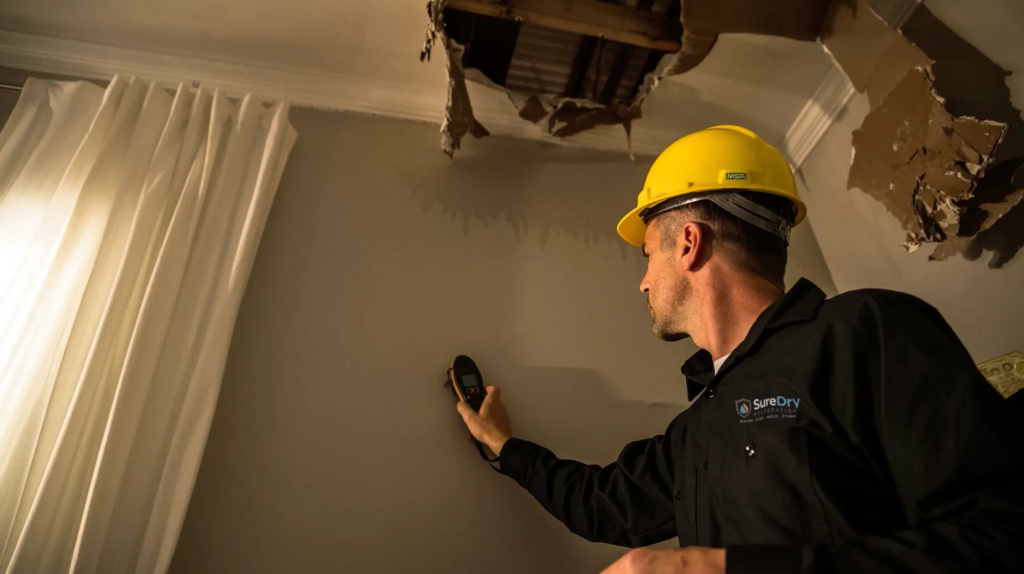
Why Chino Storms Behave the Way They Do
Chino sits on the old dairy flats of the Chino Valley, and the ground here barely tilts. Runoff spreads sideways across driveways and side yards instead of draining away. South of town, the Prado Flood Control Basin collects what the valley sheds. Chino Creek and Cucamonga Creek carry it there. When a winter system stalls over the Inland Empire, those channels run hard and the flats hold water.
The housing stock splits the city into two different repair problems. Around downtown Chino and Chino Avenue, much of the core predates 1980. Those homes carry older roof underlayment, wood-framed eaves, and original galvanized supply lines. College Park, Sunset Trails, and The Preserve are largely slab-on-grade tract housing. Concrete tile roofs and attached garages sit close to grade.
That difference decides the scope. On an older Chino Avenue bungalow, wind-driven rain enters at a lifted eave and travels along the ceiling plane. In a Preserve home, the same storm pushes water under the garage slab edge and into the first course of drywall.
Chino Storm Numbers Worth Knowing
Rain here does not arrive evenly. San Bernardino County logged 2.77 inches of water-year precipitation in 2021 and 8.31 inches in 2023.1 The 36-year mean is 6.33 inches. Two or three atmospheric-river days can deliver most of a season. Seven severe-storm major disaster declarations have designated San Bernardino County since 1995.2 The latest came in April 2023 for winter storms, straight-line winds, flooding, and mudslides.
Flood insurance is rare in Chino. The county has 864 NFIP claims on record, but only five come from Chino's 91708 and 91710 ZIP codes.3 Those same ZIPs hold about 540 NFIP policy records across 27,261 Chino households.4 In practice, storm water inside a Chino home is documented under the homeowner's own policy.
- NOAA NCEI Climate at a Glance, San Bernardino County water-year precipitation, 1990–2025.
- FEMA Disaster Declarations Summaries, San Bernardino County severe storms, 1995–2023.
- FEMA NFIP redacted claims, ZIPs 91708 and 91710, current to June 2026.
- FEMA NFIP redacted policies and US Census QuickFacts households, Chino city.
Water Still Moving Through Your Chino Home?
A storm loss in Chino gets worse quietly. The roof stops leaking, the puddle dries, and the moisture stays inside the wall cavity. SureDry Restoration Inc. runs storm response into Chino from Pomona, down the 71. Tell us what you are seeing and we will scope it. Call (909) 573-5760 or request storm damage help.
How We Work a Chino Storm Loss
A storm call in Chino is really two jobs at once. Something has to stop the water coming from outside, and something has to pull the water already inside. The order below is built around Chino roofs, Chino slabs, and the way this valley drains.
On pre-1980 homes near downtown Chino and Chino Avenue, wind gets under aging underlayment at the eave. We tarp and batten the failed plane before touching the interior, because the next band will reopen it.
Water on Chino's dairy flats runs sideways, not down. We map moisture from the entry point outward, not just where the stain shows. Older wood-framed eaves carry it along the ceiling plane; newer tract slabs carry it along the perimeter.
Concrete tile roofs, stucco over wood frame, and slab-on-grade floors each hold water differently. In the older core, corroded galvanized supply lines near the wet zone get flagged, not buried behind new board.
The Prado Flood Control Basin holds water south of town, and the water table runs high across southern Chino. We monitor daily until readings hold, and rebuild starts once the assembly is dry, not just the surface.
Storm Damage Chino Owners Usually Spot Too Late
Most Chino storm calls arrive days after the weather, not during it. The visible water dries, and the damage keeps working behind stucco, tile, and slab.
Newer tract roofs in The Preserve and College Park use concrete tile over felt underlayment. One slipped or cracked tile leaves the felt exposed, and the next Inland Empire system soaks the sheathing.
In the older core near downtown Chino, wind-driven rain enters where the roof meets the wall. The stain shows several feet inside, so the wet framing sits well away from the mark.
Attached garages on Chino's newer slab-on-grade tracts sit close to grade, and sheet flow crosses the flats. A faint dirt line at the garage slab edge means water came in once, and the shared wall wicks it upward.
Southern Chino sits nearest the Prado Flood Control Basin, where the water table runs high. A storm-wetted wall there dries slowly, so odor is often the first honest signal — and the point where mold remediation in Chino enters the scope.
Why Chino Owners Bring Us the Storm Work
Plenty of restoration companies can list equipment. The reasons below are specific to Chino, and to how a storm loss here actually behaves.
A Pomona Base That Reaches Chino Down the 71
SureDry Restoration Inc. works out of Pomona, and Chino is a straight run down the 71 or Central Avenue. Being this close means a tarp goes up before the next band arrives.
One Chino Contract From Tarp to Finished Drywall
Mitigation, drying, and the rebuild all stay under one SureDry Restoration Inc. contract in Chino. That matters on a Preserve tract home where the same wall gets opened, dried, and closed.
Built for Both Halves of Chino's Housing Stock
Pre-1980 homes around Chino Avenue and newer slab-on-grade tracts fail in opposite ways. We scope the older core for eave and underlayment entry, and the newer tracts for slab-edge wicking.
San Gabriel Valley and Inland Empire Coverage Around Chino
Chino sits between our Pomona base and the rest of the Inland Empire, and we cover both sides. The same crews serve Ontario, Claremont, Diamond Bar, La Verne, Walnut, Altadena, and Los Angeles.
Chino Neighborhoods and Corridors We Cover
Storm response in Chino changes street by street, so here is how we read the map. Each area below fails in its own way, and the scope is written for that.
The pre-1980 core, where wind lifts older underlayment and the ceiling stains well inside the room.
Newer slab-on-grade tract housing, where slipped concrete tile and garage slab-edge flow drive most storm losses.
Another newer Chino tract, where attached garages and flat lots let runoff reach the threshold before a drain.
Established Chino housing, where limb strikes and overflowing gutters send water into fascia and soffit.
The lowest, flattest ground in the city, with a water table that slows every dry-out.
The commercial spine, where shops, warehouses, and offices take the same runoff as the houses.
See the Chino service area for our full local coverage. You can also browse every area we serve across the San Gabriel Valley and Inland Empire.
Not Sure If Your Chino Storm Loss Needs Full Restoration?
Wondering whether that ceiling stain off Chino Avenue is cosmetic or structural? Or whether the dirt line in your Preserve garage means the wall behind it is wet? SureDry Restoration Inc. handles the dry-in, the drying, the claim documentation, and the rebuild under one contract. Our crews run into Chino from Pomona, down the 71. Call (909) 573-5760 to request storm damage restoration in Chino.
Chino Storm Damage Questions
These are the questions Chino owners ask most after a winter system moves through. The answers are specific to this city and this kind of loss.